The PMCA’s Current Recommendations on the Use of Diatomaceous Earth (DE) and Sevin in Martin Nests

For the past 13 years, the Purple Martin Conservation Association has been recommending the application of DE to martin nests as a way to help eliminate populations of nest mites, martin fleas, and bedbugs (it has little effect of blowfly larvae since they are soft skinned). We no longer recommend it or sell it. Read below to find out why.

We promoted its use because unlike chemical pesticides, such as Sevin, which poison insects and mites (and martins?), DE kills mechanically, by scratching arthropod exoskeletons, leading to desiccation of the critter. It was deemed 100% safe, since organisms could even ingest the material and it would simply pass through them, causing no harm. DE is nothing more than fossilized diatoms, oceanic invertebrates, calcareous in nature, grit-like. It is even used as a food additive.

Unfortunately, DE was never that potent as a parasiticide (see Hill, III, J. R. 1984. More evidence that timing is most important factor in parasite control. Nature Society News 19(1):1-5; and Hill, III, J. R. 1983. Here’s an introduction to the common parasites of martins. Nature Society News 18(4):1-6.). DE will kill some, but not all, of the pests in a martin nest. And if DE got wet, it lost its effectiveness. Still, it did provide some level of parasite control.

Much more effective, and totally safe, is the practice of “Total Nest Replacement,” where the landlord completely removes the infested nest when the young martins are about 10-days-old, replaces the nest with soft, dried pine needles (or cedar shavings), then repeats the action when the young are about 20-days-old. (See Update 9(2) in the PMCA’s archives on their web site for the article: “How & Why to Do Nest Replacements for Purple Martins.”) This method of parasite control requires accessible housing and a time commitment from the landlord, but it is very effective and totally safe for the martins.

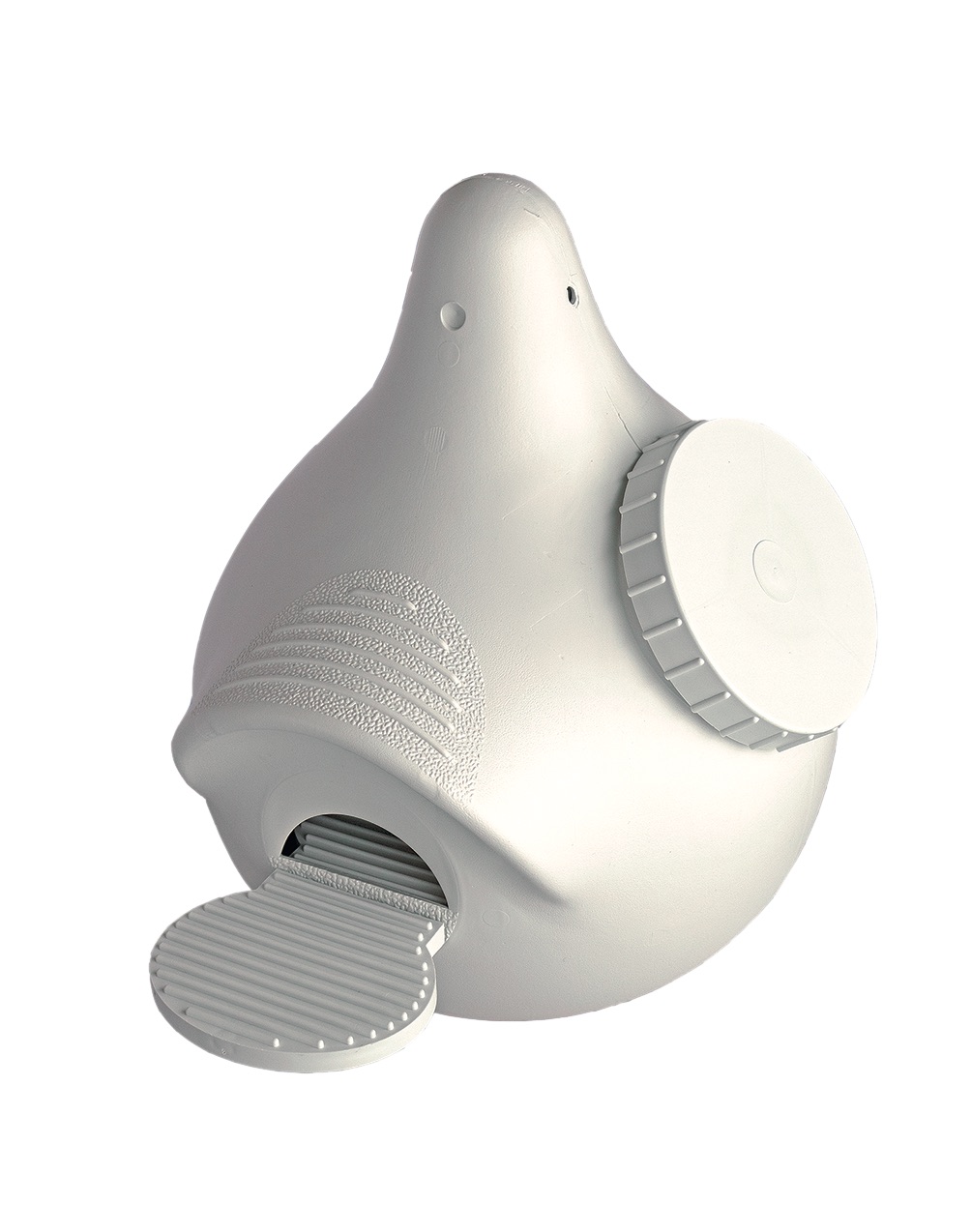
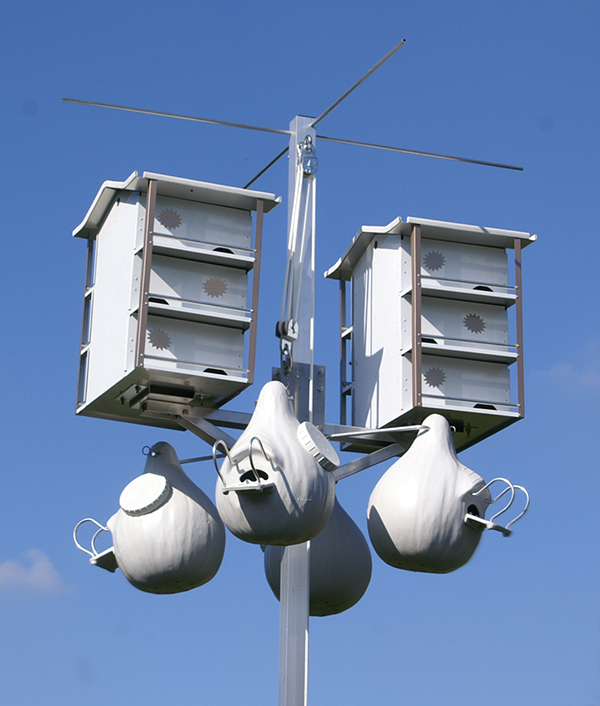
During the summer of 2000, the PMCA had a video surveillance camera in an active martin gourd, recording every action for 72 straight days, 24 hours a day. We were amazed to see how much, and how often, nestling martins aggressively flap their wings during their last week or so in the nest, strengthening their wing muscles, and “practicing” for their maiden flight. What we weren’t prepared to see was the incredible amount of dust and debris these “flap-a-thons” kicked up in the cavity for the martins to breathe (see photo).

DE has been implicated as possibly causing silicosis and animal lung disease in organisms that breathe it. Well, we now know that when martins exercise inside their nest cavities, they WILL breathe in DE and anything else (Sevin, sulfur, etc.) landlords place in their nests.

In light of this, the PMCA no longer sells or recommends DE. Is DE harmful to martins? We don’t know. But we no longer think it is responsible for us to promote its use by martin landlords.

What about Sevin? The PMCA wishes to thank Kenny Kleinpeter and Chuck Abare for the literature search they did on the con and pro sides of the Sevin debate. Both men did great jobs. What did we learn?

Tests have shown that Sevin is incredibly potent at killing nest parasites in martin nests (see Nature Society News citations above). Is Sevin safe to use in martin nests? Discussions with veterinarians and researchers at the National Wildlife Health Research Center raised enough warning flags to suggest that Sevin is not “safe” for use in martin nests. We cannot offer data to prove this, because it has not been tested in martins. By the same token, neither can anyone offer proof that Sevin is safe for use in martin nests. While carbaryl has low toxicity to birds, it does have sub-lethal effects. It has been shown to be an endocrine disrupter in birds, which is serious enough for any responsible landlord to stop using it. See: (Grue, Gilbert, and Seeley. 1997. Neurophysiological and behavioral changes in non-target wildlife exposed to organophosphate and carbamate pesticides: thermoregulation, food consumption, and reproduction. American Zoologist 37:369-388).

Should the PMCA conduct its own tests to determine whether Sevin is safe or harmful to martins? I have been reluctant to do so in the past since its use is illegal in bird nests, but now feel it may be in the best interests of martins and their landlords to do so. We have contacted the National Wildlife Health Research Center and asked for their assistance in setting up a study to examine the effects of Sevin on martin nestlings, for the 2001 martin season.

James R. Hill, III
Executive Director/Founder
Purple Martin Conservation Association

Back to Archives